
How Food Photographers Make Ice Cream That Never Melts
That flawless scoop under hot studio lights usually isn't ice cream at all. It's decades of styling tricks, from mashed potato to dyed shortening, and a modern pivot back toward the real thing.
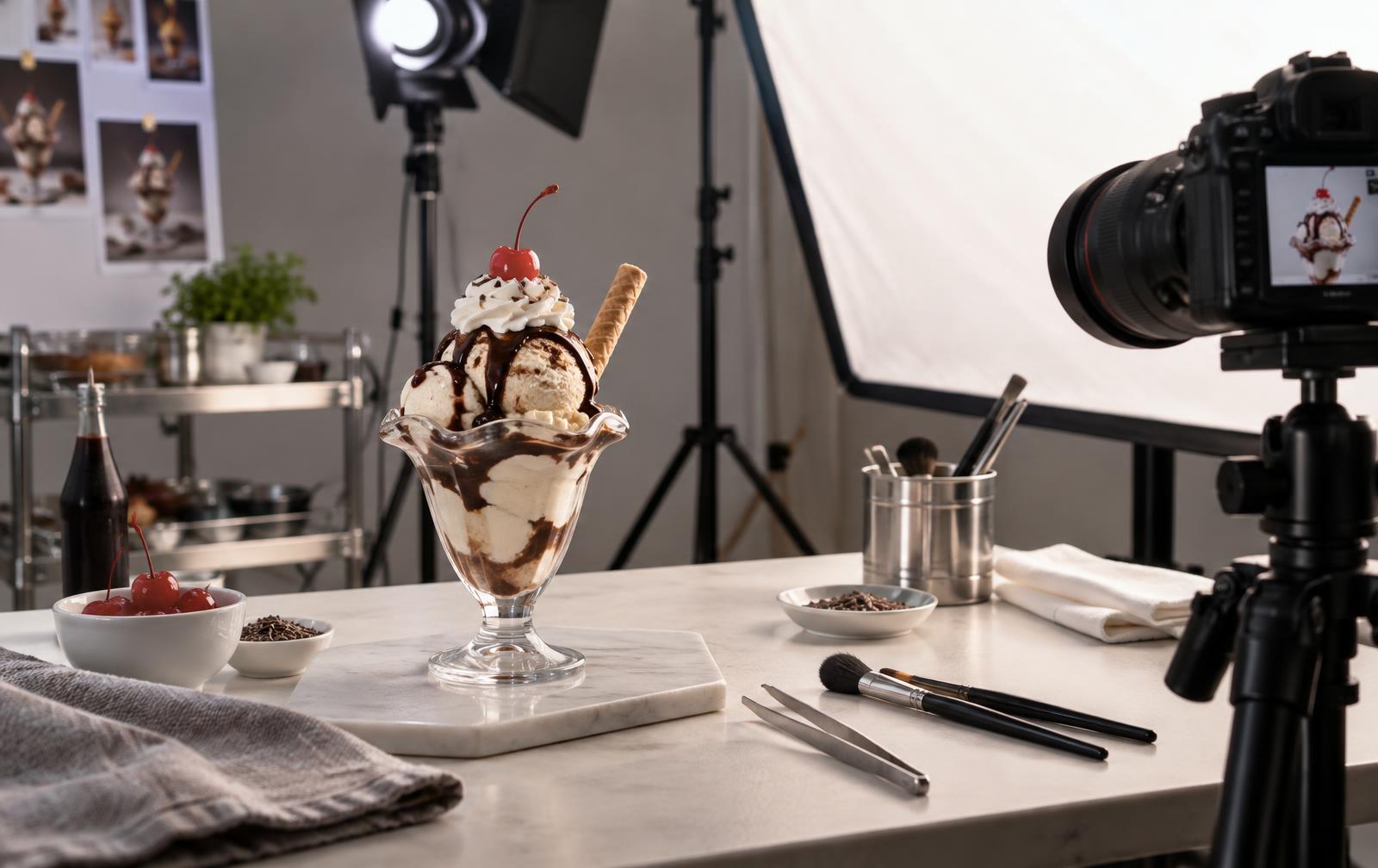
The scoop of ice cream that never melts in a magazine ad or fast-food billboard is very often not ice cream at all. For decades, food photographers and stylists have built convincing stand-ins from mashed potato, shortening and food coloring, because real ice cream collapses within minutes under the heat of studio lights. It's one of the oldest, most practical open secrets in commercial photography, and understanding how it works tells you a lot about the gap between what food looks like and what it actually is.
Why real ice cream is such a hard subject
Studio lighting for food photography is typically hot, whether from tungsten hot lights or the heat strobes still throw off during a long shoot, and a single setup can take anywhere from twenty minutes to several hours to light, compose and adjust before the actual shutter click. Ice cream starts softening the moment it leaves the freezer, and its structure, tiny ice crystals and air bubbles suspended in a fat-and-sugar matrix, breaks down fast once temperature rises even slightly above freezing. A scoop that looks camera-ready can visibly slump within minutes, long before a stylist has finished checking focus, background and garnish placement.
That mismatch, a subject with an extremely short shelf life against a process that needs a stable subject for a long time, is the entire reason stand-ins exist. It's the same underlying tension explored in other food-styling deep dives, though ice cream is probably the most famous case because the failure mode, a sad puddle instead of a proud scoop, is so visually obvious.
The classic stand-ins
The most enduring trick is mashed potato. Scooped with an ice cream scoop and given the right texture (usually a bit stiffer and drier than you'd serve at dinner), mashed potato holds a convincing scoop shape for hours, doesn't melt, and can be tinted with food coloring to resemble vanilla, chocolate or strawberry. It has essentially no smell to interfere with a long shoot and can be reshaped by hand between takes, something no real dessert allows.
The other classic approach is a mixture of vegetable shortening (sometimes with a little powdered sugar or corn syrup for texture) whipped and tinted with food coloring, then scooped and frozen briefly just to firm the shape before the shoot, without ever needing to stay cold once it's in front of the camera. This gives a glossier, creamier-looking surface than mashed potato and holds up even better under prolonged heat, which is why it became a favorite for long commercial shoots [2](https://www.youtube.com/watch?v=2iBDcK2cG0Q).
Drips, steam, and other classic illusions
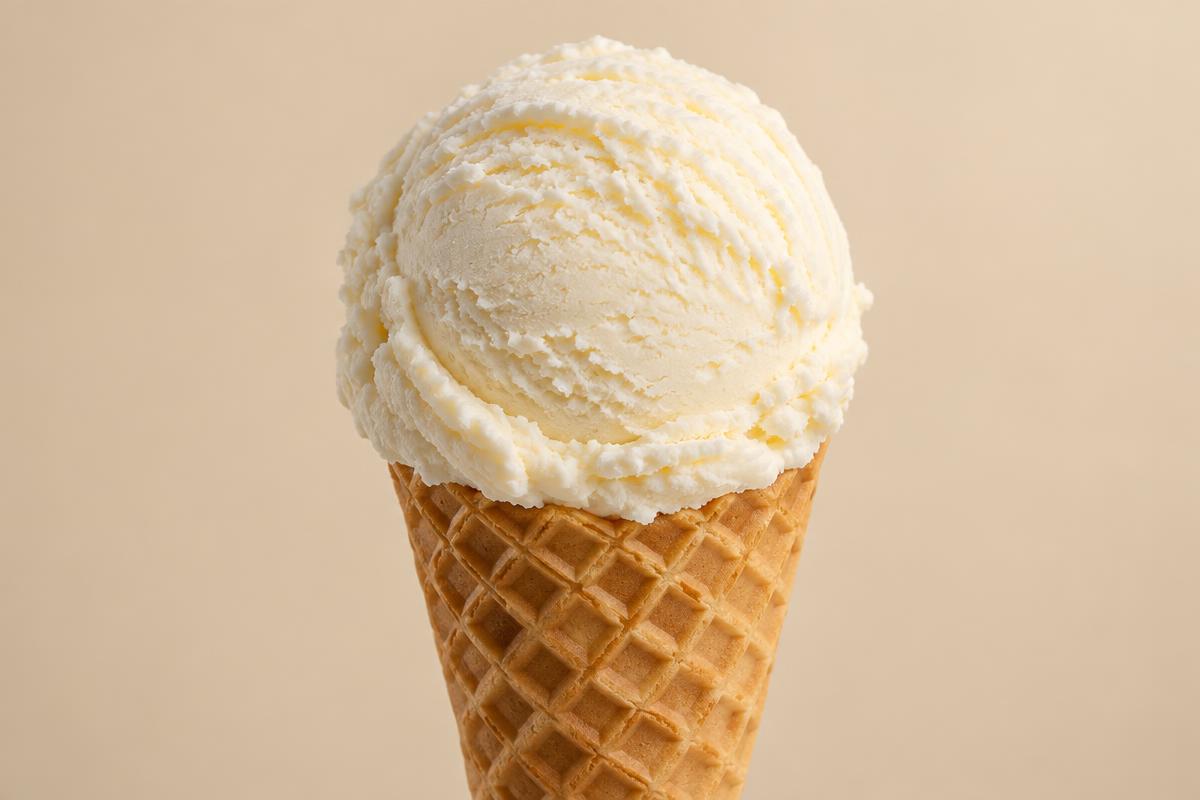
A convincing melt drip running down a cone is frequently not melted ice cream at all, but corn syrup, sometimes thinned honey, or in some historical cases diluted glue, painted or dripped on with a brush or syringe exactly where the photographer wants it, then held in place by its own thickness rather than gravity and time. This lets a stylist create the same “perfect drip” shot after shot without the mess or unpredictability of an actual melting scoop.
Steam rising off a hot dish, another food-photography staple, has a similarly manufactured history: stylists have long used small tufts of cotton wool, sometimes lightly dampened or warmed, positioned and lit to catch the light the way real steam does, since actual steam disperses too quickly and unpredictably to reliably compose around. Cereal shot with milk faced its own version of this problem, real milk makes cereal go soggy within a couple of minutes, so glue was a well-documented substitute in still photography for years, since it has a similar opacity and viscosity to milk without ever softening the cereal.
The rules that actually govern this
This isn't an unregulated free-for-all. In several jurisdictions, including under long-standing guidance enforced by the U.S. Federal Trade Commission, food advertising has specific truth-in-advertising obligations: if an ad is showing the actual product being sold, say, a specific brand's ice cream, rather than a generic prop representing “ice cream” as a concept in an unrelated scene, the hero product itself generally needs to be real, and any techniques used have to still represent how the product actually looks and performs. Using a stand-in to represent a competitor's melting scoop in a comparison ad, or implying a product performs better than it does, crosses into deceptive advertising territory the FTC has pursued action over historically.
This is different from decorative, non-deceptive props: a generic mashed-potato scoop used purely as a lighting stand-in while the crew dials in focus and background, swapped for the real product before the final hero shot, sits in a different category than deceiving a viewer about the actual product's performance.
The shift back toward the real thing
Two changes have pushed a lot of contemporary food photography back toward shooting genuine ice cream. First, LED lighting has largely replaced hot tungsten lights and reduces how much a subject heats up during a shoot, buying real ice cream meaningfully more time in front of the camera. Second, digital cameras let photographers see and adjust a shot instantly rather than waiting on film processing, dramatically cutting the number of takes and the total time a scoop needs to survive.
The modern workflow for a real-ice-cream shot usually means pre-lighting and pre-composing the entire scene using a stand-in scoop, swapping in the actual product only at the very last moment, sometimes using scoops pre-frozen rock-hard or briefly re-frozen between shots, and firing off many rapid frames to capture the narrow window before melting becomes visible. It's more logistically demanding than using a permanent fake, but it produces a result that's both accurate and, for editorial and social content especially, increasingly expected by audiences who've grown skeptical of obviously staged food shots, the same skepticism worth keeping in mind when looking at how animated food is deliberately idealized for a completely different, non-deceptive reason.
| Shot need | Classic fake approach | Modern real-food approach |
|---|---|---|
| Stable scoop shape | Tinted mashed potato or shortening blend | Real ice cream, pre-frozen hard, shot fast under LEDs |
| Melt drip | Corn syrup or diluted glue painted on | Real melt, captured in a tight time window with rapid frames |
| Rising steam | Cotton wool tufts, lit and positioned | Real steam, shot immediately off the stove with quick capture |
| Milk in cereal | Glue, historically, for opacity without sogginess | Real milk added seconds before the shutter click |
| Hero product in an ad | Not permitted for the actual advertised product | Real product required, styling limited to presentation only |
How long common desserts hold up under hot studio lights before visibly melting
estimated minutes before visible melt (practical studio estimate)
Rough, practical estimates from working food-styling practice under warm studio lighting, not a controlled lab measurement.
Why the fakery is worth knowing about
None of this is really about being duped. It's a genuinely clever, decades-old craft solving a real physical problem, similar in spirit to the deliberate exaggeration explored in how presentation changes perceived quality. Knowing the mashed-potato trick doesn't make ice cream ads less fun to look at. If anything, spotting a suspiciously glossy, suspiciously patient scoop becomes its own small pleasure.
Frequently asked questions
Sources and further reading
Next time you see a suspiciously flawless scoop in an ad, look closely at the surface sheen and the drip pattern. If you spot a fake in the wild, or you've styled one yourself, we'd genuinely like to hear how it was built.
Filed under
More from Science
Why Lemon and Cinnamon Together Taste Like Cola
It is not a coincidence and it is not magic. Lemon and cinnamon taste like cola because cola was built from citrus oils and warm spice in the first place.
Tomás Reyes · · 10 min read
What Miracle Berry Actually Does to Your Taste Buds
Miracle berry doesn't numb your tongue or trick your brain. A single glycoprotein hijacks your sweet taste receptor and turns acid into its trigger.
Tomás Reyes · · 10 min read
Why Cilantro Tastes Like Soap to Some People
It's not pickiness. Cilantro and soap really do share aroma chemistry, and a specific stretch of DNA near a smell-receptor gene explains part of why some people notice it and some don't.
Clara Bennett · · 9 min read