
Soup Dumpling Lasagna: What It Is and Whether It Works
All the flavor of xiao long bao with none of the pleating. The trick is where you put the broth.
Last updated: September 14, 2026.
Safety first, because this dish involves raw ground pork and a lot of hot steam. Ground pork must reach an internal temperature of 165°F at the center of the dish, checked with an instant-read thermometer pushed into the middle layer, not just the top. Pink or soft filling is not acceptable, and "it looked done" is not a doneness test with layered fillings. Steam burns are the other real risk: a ramekin that has been in a covered steamer for 25 minutes is hot enough to blister, and the plume that escapes when you lift the lid is hotter than boiling water. Tilt the lid away from your face, use tongs or a folded towel to lift the dish, and let it rest five minutes before eating. Allergen note: wonton wrappers contain wheat, the filling typically contains soy and often sesame, and the popular shrimp variation adds shellfish.
What soup dumpling lasagna actually is
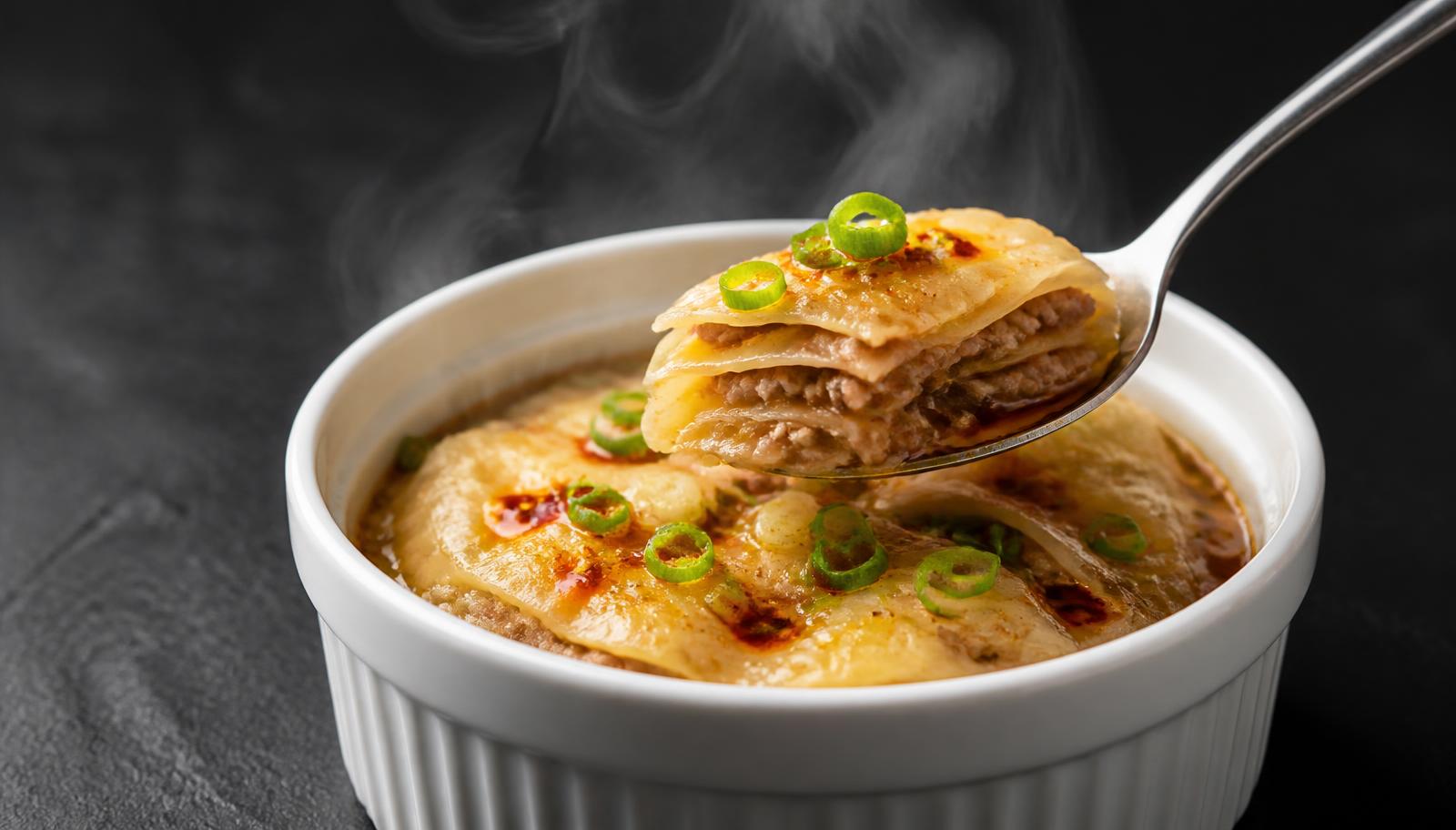
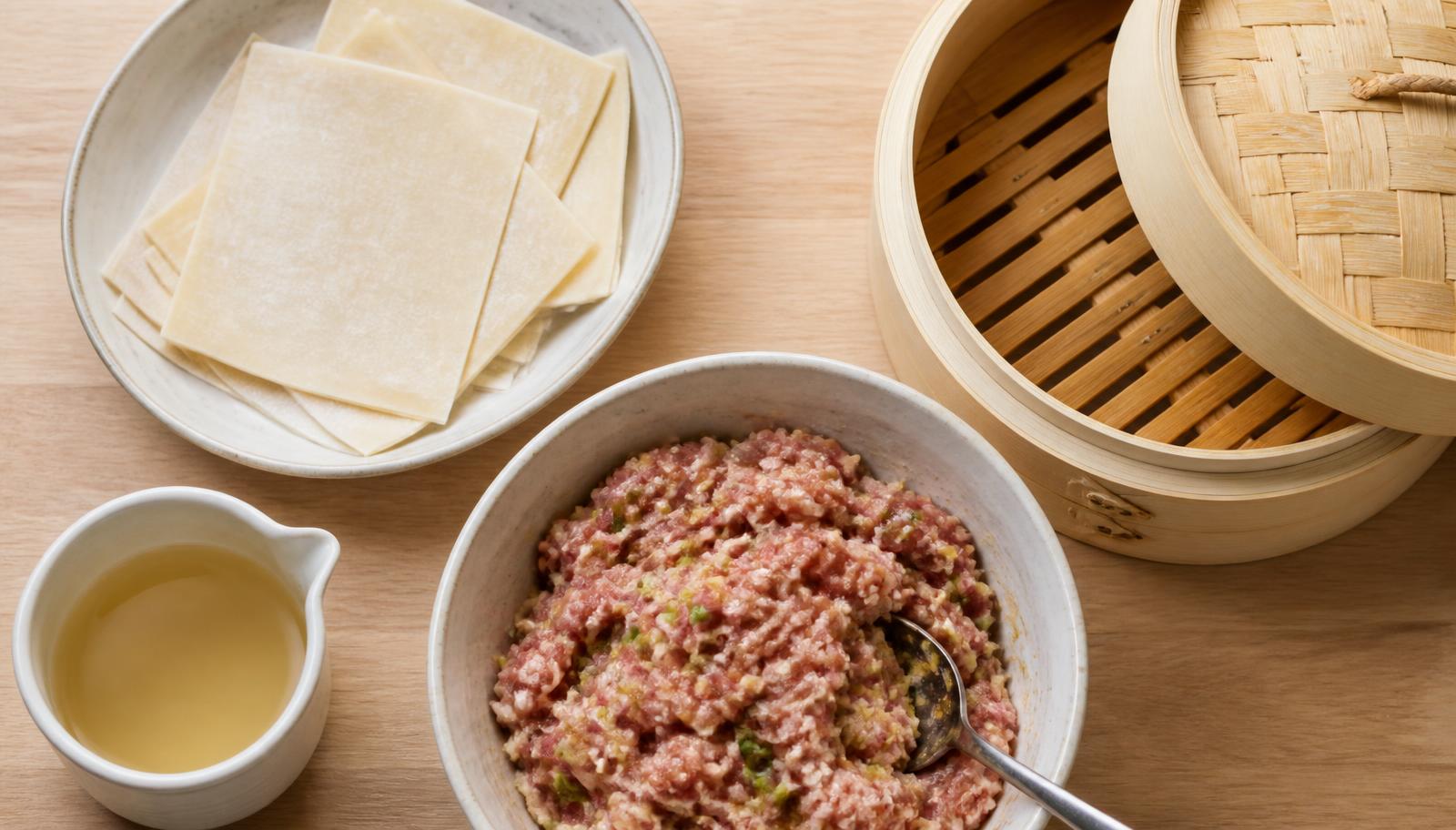
Take everything that goes inside a soup dumpling and stop trying to make it into a purse. You season ground pork with ginger, scallion, soy sauce, Shaoxing wine or rice wine, white pepper and sesame oil. You line a ramekin with a square wonton wrapper, add a thin layer of filling, spoon in broth, add another wrapper, and repeat until you run out of room. Then it steams, covered, for roughly 25 to 35 minutes depending on the depth of your dish.
What comes out is a wobbly, savory little casserole. The wrappers hydrate into something closer to fresh pasta than to a dumpling skin, the pork releases its own juices into the broth, and you eat it with a spoon. Versions across the recipe blogs covering it, including I Am a Food Blog, White on Rice Couple and Kalejunkie, differ mostly in the number of layers, the broth quantity, and whether they finish with chili oil, black vinegar or both.
Where the trend started, and when
The dish surfaced on short-form video and moved outward from there. Good Morning America covered it as a viral deconstructed soup dumpling nicknamed Chinese lasagna, and BuzzFeed ran a how-to as the format spread. Individual creators then made it their own: The Modern Nonna published a pork version, Plantbaes a vegan one, and home cooks on r/soup traded notes on layer counts and broth ratios.
We are not going to attach a view count to it. The dish is widely described as viral across TikTok and Instagram, and that description is well supported by the coverage, but specific view or share figures are unverified unless they appear on the source pages, so treat any number you see quoted with suspicion. What we can say as of September 2026 is that it has crossed from a single format into a family of variations, which is usually the sign a trend has legs beyond one week.
Video placeholder: the widely shared assembly clip lives on Instagram at this reel. We have not embedded it here because Instagram requires its own player, so follow the link to watch the layering in real time. It is the fastest way to see how thin each pork layer should be.
Is it really like a soup dumpling?
Partly, and the difference is worth understanding. In a real xiao long bao, the soup is not poured in. Cooks fold chilled aspic, usually a rich pork or chicken stock set with gelatin from skin and bones, into the filling. It is solid when the dumpling is pleated and melts into liquid as it steams, which is why the wrapper can hold it. That mechanism is the whole engineering achievement of the dish.
Soup dumpling lasagna skips the engineering. The broth is just broth, added by the spoonful between layers, and the dish holds it because a ramekin has walls. Flavor-wise you get remarkably close, especially if your broth is good. Texture-wise it is a different animal: less burst, more spoonable stew. If you want the burst, you have to make the real thing, and that is a separate afternoon.
| Soup dumpling lasagna | Traditional xiao long bao | |
|---|---|---|
| Hands-on effort | Layer and pour, about 15 minutes | Make aspic, roll skins, pleat each dumpling |
| Total time | Roughly 45 to 55 minutes | Several hours, plus chilling the aspic overnight |
| Skill needed | None beyond seasoning and steaming | Real practice, 18 or more pleats per dumpling |
| Soup mechanism | Broth poured between layers | Gelatin-set stock melting inside the wrapper |
| Wrapper | Store-bought wonton squares | Hand-rolled, thin at the edge and thicker at the base |
| Cleanup | One ramekin, one bowl, one steamer | Rolling surface, aspic pan, trays, steamer, flour everywhere |
| What you get | The flavor, spoonable | The flavor plus the burst of soup |
The one thing that decides whether it works
Almost every failure photo of this dish shows the same problem: a gummy, pale, undercooked bottom layer. The cause is not the steamer or the timing. It is dry stacking. If you press wrappers directly onto each other with only filling between them, they fuse into a dense sheet that steam cannot penetrate, and the moisture that would have cooked them never arrives.
Put broth between every layer, including under the first wrapper. A spoonful or two per layer is enough. That liquid is what hydrates the starch and carries heat inward, which is exactly the mechanism that makes lasagna noodles work in a wet sauce and seize up in a dry one. The rest is small stuff.
- 1
Start with liquid, not pasta
A spoonful of broth in the bottom of the ramekin before the first wrapper keeps that layer from welding itself to the dish.
- 2
Keep pork layers thin
Around a tablespoon spread thin per layer. Thick pucks of pork stay cold in the middle long after the wrappers look done, which is how you end up chasing 165°F for another 15 minutes.
- 3
Do not overfill the ramekin
Leave half an inch at the top. The filling swells and the broth bubbles, and a dish filled to the rim boils over into your steamer water.
- 4
Cover it while it steams
Foil or a lid stops condensation from dripping in and turning the top wrapper into paste. Vent it for the last five minutes if the surface looks wet.
- 5
Check the middle with a thermometer
Push the probe into the center layer, not the top. You want 165°F. If it is short, keep steaming in five-minute increments.
- 6
Rest, then finish sharply
Five minutes off the heat lets the layers set and stops the burn risk. Then chili oil, black vinegar, scallions. The vinegar is not optional if you want it to taste like the real thing.
Building broth that carries the dish
This is the part that survives the trend, because it applies to every layered steamed dumpling-style dish. Your broth is doing double duty here: cooking the wrappers and being the sauce. Watery stock produces a watery result, and no amount of soy sauce at the end fixes it.
- Use stock with body. Anything gelatinous when cold, like a chicken stock made with wings and feet, will coat the wrappers instead of pooling under them.
- Fortify shortcuts. If you are using boxed broth, simmer it for 10 minutes with a smashed scallion, two coins of ginger and a splash of Shaoxing wine before you use it.
- Season the broth, not just the pork. It should taste slightly too seasoned on its own, because the wrappers will absorb and dilute it.
- Add a pinch of sugar. A quarter teaspoon rounds out soy sauce and reads as depth rather than sweetness.
- Finish with acid. Chinkiang black vinegar at the table is what makes soup dumplings taste like soup dumplings.
The same logic runs through other layered steamed dishes: Cantonese steamed rice rolls, dumpling casseroles built on gyoza wrappers, and the various steamed noodle pies that show up in home cooking across East Asia. In all of them the liquid is a cooking medium first and a sauce second. If you like the way that thinking translates to Western food, our guide to dinners that look like you tried harder than you did leans on the same one-pan liquid logic, and the one-pan Tuscan chicken is essentially the same trick with cream instead of stock.
Variations that actually hold up
Shrimp works beautifully if you chop it coarsely and mix it half and half with pork, which keeps it from turning rubbery. For a vegetarian build, finely chopped shiitake, firm tofu crumbled fine and a little minced water chestnut give you the fat-free body the pork was providing, and a mushroom-heavy broth compensates for what you lose. The vegan version from Plantbaes is built on roughly that logic.
The surprising one: napa cabbage. A layer of finely shredded, salted and squeezed napa between the pork layers releases just enough water to help the wrappers cook and adds the sweetness real soup dumpling filling has. It is the single cheapest upgrade to the dish.
Our verdict
Make it. Not because it replaces xiao long bao, which it does not, but because it turns a restaurant dish into a weeknight one at a genuine skill discount. Twenty minutes of work for something that tastes like a Shanghai dumpling house is a good trade. The trend's honest weak point is the name: there is no lasagna in it, and there is no soup dumpling mechanism in it either. It is a steamed layered pork and broth dish, and it is very good. If you enjoy watching food trends earn or fail their reputations, our look at the food queues people wait hours in is the other side of that coin, and there is more of this sort of thing in everything we are tracking right now. You can also browse the dumplings tag for related pieces.
Frequently asked questions
Sources and further reading
- Good Morning America: viral deconstructed soup dumpling dubbed Chinese lasagna
- I Am a Food Blog: dumpling lasagna
- White on Rice Couple: soup dumpling lasagna
- Kalejunkie: viral dumpling lasagna
- BuzzFeed: how to make viral dumpling lasagna
- The Modern Nonna: viral pork dumpling lasagna
- Plantbaes: vegan soup dumpling lasagna
- Instagram reel showing the layering
- r/soup discussion thread
If you make it, tell us your layer count and whether you added the napa cabbage, because that is where the versions really diverge. And if you think this dish is a step too far from xiao long bao to deserve the name, we would like to hear the case.
Filed under
More from Trending

Why People Are Lining Up for Hours for Potatoes and Frozen Yogurt
The queue is the product now. The food is almost beside the point.
Hana Yoshida · · 8 min read
Every Meal Studio Ghibli Made You Desperately Want to Eat
No animation studio has ever made a fried egg look more like a religious experience.
Hana Yoshida · · 10 min read